ImmersiLab - Immersive Technology & Simulation Testbed
In the testbed, we have at our disposal a numerous technical devices that help us to develop and test XR applications corresponding to the latest trends. Software support is also an integral part.
The Immersive Technology & Simulation Testbed at the XR Institute is an advanced testbed dedicated to the research, development, and validation of immersive technologies, including Virtual (VR), Mixed (MR), and Augmented Reality (AR). It provides an experimental environment for creating interactive applications that merge digital and physical realities, supporting human-centred DeepTech solutions aligned with the Industry 5.0 vision.
The key technology focus includes XR system integration, immersive simulation, and human-machine interaction. The testbed combines XR headsets, AR devices, high-performance computing units, and systems for motion capturing and prototyping. The software stack includes Unity3D, Blender, and Python-based data analytics, supporting real-time rendering, 3D modelling, and behavioural data analysis.
Advanced computing
The testbed offers up to date VR ready computers with powerful graphics and computing power, equipped with Unity 3D engine and Blender as the main platforms for application development.
Extended reality headsets
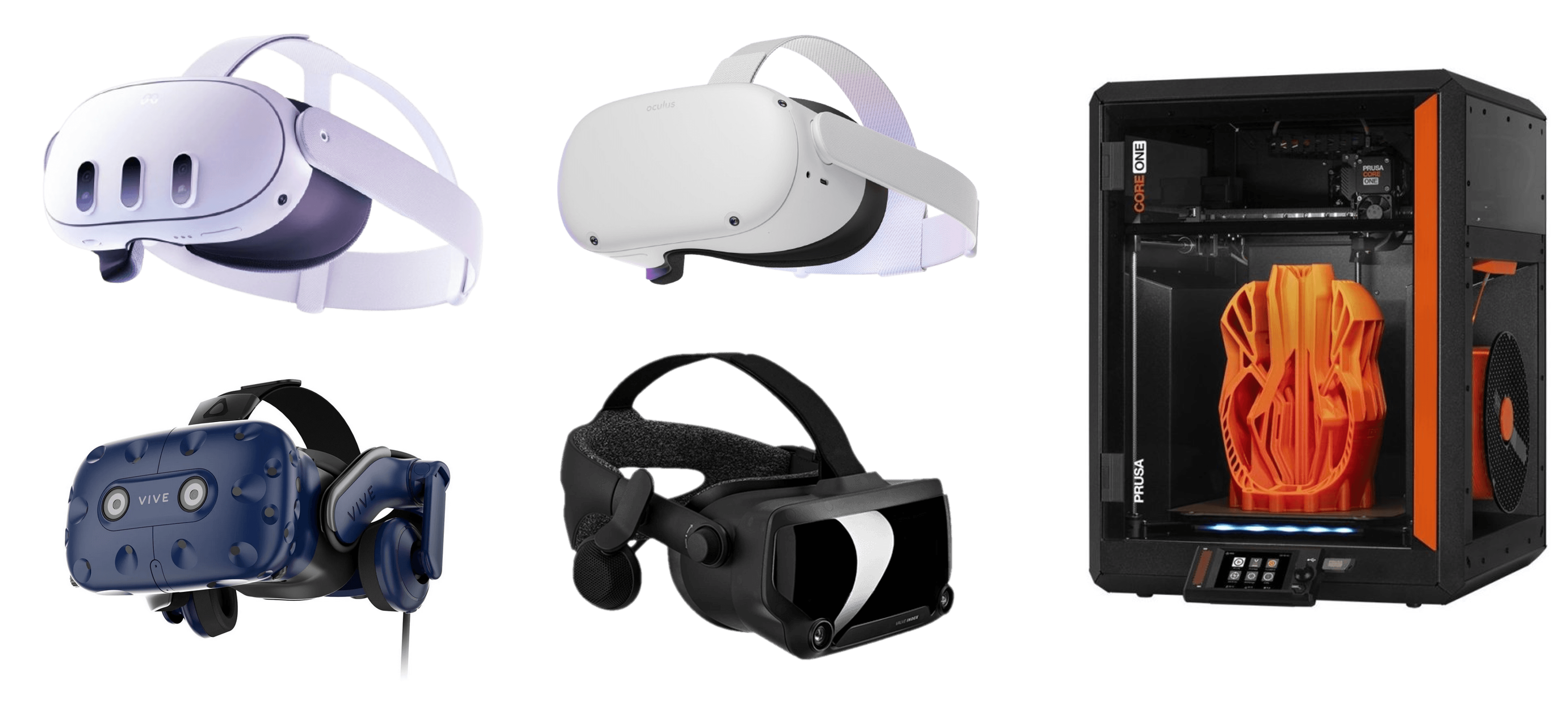
Numerous XR headsets are available for development and testing, including Meta Quest 3, Pico 4, Valve Index, HTC Vive Pro 2 and many others.
Devices for augmented reality
The augmented reality application can be developed using Hololens, Hololens 2, phones and tablets.
Prototyping
Rapid production of physical prototypes is possible thanks to our Prusa CORE One FDM/FFF 3D printer. The robust steel exoskeleton frame ensures structural rigidity and long-term durability, while the relatively compact footprint and generous build volume of 250 x 220 x270 mm provide a balance of workspace and space efficiency.
Animations
Creating computer animations is easier and faster with the Motion Capture suit Perception Neuron Studio Inertial System. It is a kinematic suit for detecting a person's position in real time. It contains a total of 17 motion sensors. As an additional device, we use Motion Capture Perception Neuron Studio Gloves containing 6 motion sensors for grip evaluation or gestures simulation.
Media processing and visualization
360° VR ready cameras (Kandao Qoocam, Insta 360 Pro) + accessories for creating 360° VR videos.